01
The Department
A single surgical service uniting aesthetic and reconstructive disciplines.
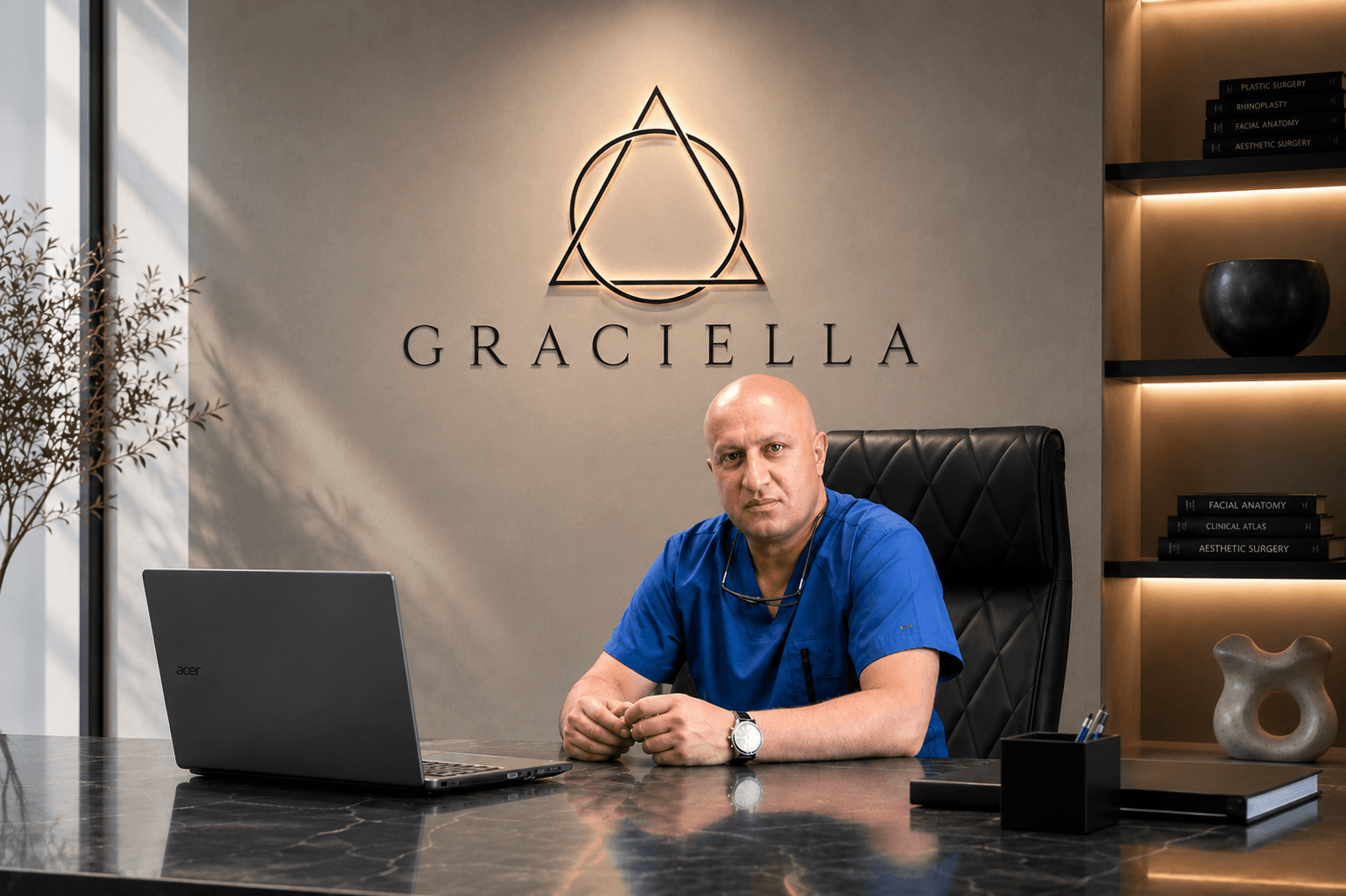
The Department of Maxillofacial & Aesthetic Surgery at Erebouni Medical Center has been led by Dr. Ara Hayrapetyan since 1998. It brings aesthetic surgery and the reconstructive surgery of the face and facial skeleton together under one discipline, rather than treating them as separate concerns.
The work spans the soft tissue and the structure beneath it, and is planned around five principles that recur across every area: identity, balance, function, precision and longevity. More than three decades of continuous practice sit behind that approach.
02
Two Disciplines
Aesthetic refinement and maxillofacial reconstruction, in one pair of hands.
Dr. Hayrapetyan is a plastic and maxillofacial surgeon, trained in both fields through formal residencies — maxillofacial surgery at the Institute of Surgery named after A. L. Mikaelyan, and plastic surgery at the National Institute of Health.
The two disciplines reinforce one another. Aesthetic work benefits from a working knowledge of the facial skeleton; reconstructive work benefits from an aesthetic eye. A result is judged not only by appearance but by how the structure underneath supports it over time.
03
Children's Reconstructive Surgery
Congenital and craniofacial conditions, approached with structural precision.
The department's craniofacial work includes congenital conditions of the skull and face — among them cleft lip and palate, craniosynostosis, and congenital anomalies that affect the developing facial skeleton.
This is complex, structural surgery that calls for multidisciplinary planning and careful timing. Function and form are considered together, with the aim of restoring both the way a child's face works and the way it is composed.
04
Rhinoplasty
Primary, revision and functional nasal surgery — the focus of two dissertations.
Rhinoplasty is a particular focus of the department, covering primary surgery, the more demanding work of revision, and the functional correction of nasal breathing. The airway is treated as inseparable from the shape of the nose, so function and form are planned together.
This focus is reflected in the surgeon's research: a Candidate of Medical Sciences dissertation (2005) on preventing post-rhinoplasty obstruction of the nasal valve, and a Doctor of Medical Sciences dissertation (2017) on revision rhinoplasty. More than 4,700 rhinoplasty operations have been performed.
05
Implantology & Jaw Reconstruction
Dental implantation and reconstructive work of the jaws and facial skeleton.
Drawing on the maxillofacial side of the practice, the department undertakes dental implantation alongside orthognathic (jaw) surgery and the reconstruction of the facial skeleton.
This work also extends to the correction of the jaws and paranasal sinuses, and to reconstruction following tumour treatment or injury — areas where structural accuracy and function are decisive.
06
Research & Innovation
Candidate and Doctor of Medical Sciences degrees, and more than fifty scientific publications.
The department's practice is grounded in research. Dr. Hayrapetyan holds both a Candidate of Medical Sciences degree (2005) and a Doctor of Medical Sciences degree (2017), and is the author of more than fifty scientific publications in peer-reviewed journals and bulletins.
Recurring research themes include rhinoplasty technique, the use of cartilage autografts, reconstruction of the nasal valve, revision rhinoplasty, and maxillofacial surgery — the same areas the department treats in practice.
07
Standard of Care
Assessment, planning and follow-up held to one consistent standard.
Treatment begins with assessment and honest discussion. Where it helps, planning is supported by three-dimensional modelling and, for the internal structures, a cone-beam CT scan — so expectations and surgical plan are set out clearly before anything is decided.
Recovery is supervised through an early settling period, and results are understood to refine over months and years rather than days. What is appropriate — and what is not — is established individually.
08
Education & Training
More than thirty international training programmes since 1996.
The department's standards are informed by more than thirty international training experiences undertaken since 1996, across Europe, Israel, Russia and the United States. These include Georgetown University Hospital and the US Naval Medical Center in the United States, and the Rambam and Rabin medical centres in Israel, alongside advanced rhinoplasty and endoscopic-surgery training in San Francisco and Baltimore.
Dr. Hayrapetyan is a member of the International Society of Aesthetic Plastic Surgery (ISAPS), the European Society of Plastic, Reconstructive & Aesthetic Surgeons, and the Armenian Association of Plastic, Reconstructive & Aesthetic Surgeons.
09
The Philosophy
Five principles — identity, balance, function, precision, longevity.
Every area of the department's work returns to the same five principles. Identity: a result should look like the person, not an imposed ideal. Balance: features are considered in proportion with the whole face. Function: how something works is never traded for how it looks.
Precision: technique is matched to the individual anatomy. Longevity: a result is judged over years, not weeks. Together they describe a calm, considered approach to surgery of the face.