Foundation
His surgical career began in 1993 at the Mikaelyan Institute of Surgery, where his early years were immersed in the realities of complex clinical practice. Long before aesthetic surgery became his principal focus, he was involved in the treatment of facial trauma, reconstructive surgery, congenital craniofacial anomalies and oncological conditions of the face and jaws — the demanding work of restoring both form and function in patients whose needs extended far beyond appearance alone.
Philosophy
Those experiences became the foundation of a philosophy that continues to define his work today. Aesthetic surgery, for him, is not the pursuit of change but the pursuit of balance. Every face carries its own structure, proportions and identity; understanding that structure, respecting it, and refining it without erasing individuality remains central to his approach.
Breadth
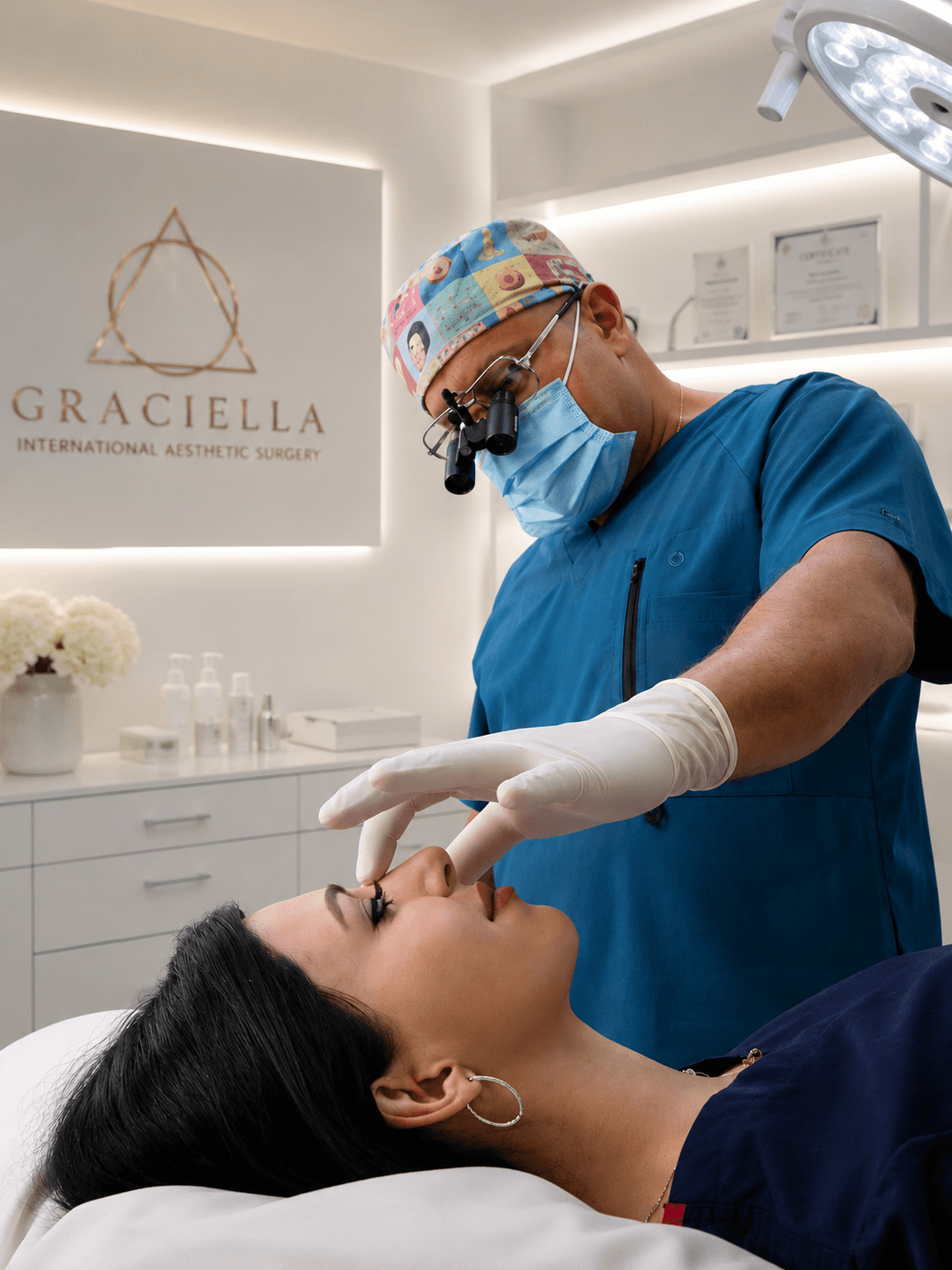
Graduating from both the dental and medical faculties, and later qualifying as a specialist in plastic surgery and maxillofacial surgery, he developed an unusually comprehensive understanding of facial anatomy, function and surgical planning. His academic work culminated in both Candidate and Doctoral dissertations dedicated to rhinoplasty — a field that would become one of the defining focuses of his professional life.
Over more than three decades in surgery, he has combined scientific research, international training, academic scholarship and extensive operative experience. He is the author of more than fifty scientific publications and has taken part in numerous advanced educational programmes and professional exchanges across Europe and beyond.
Continuity
Yet credentials alone do not explain the character of his practice. The surgeon performing aesthetic procedures today is the same surgeon who spent years treating traumatic injuries, reconstructing complex defects, managing congenital abnormalities and navigating the realities of emergency and restorative care. That breadth provides a perspective aesthetic surgery alone cannot teach — it informs judgement, planning and restraint, and the ability to recognise when less intervention creates the stronger result.
Patients often arrive seeking a procedure. What they encounter is a lifetime of surgical experience — shaped by thousands of clinical decisions, years of academic inquiry, and a deep understanding of how the face and body heal, adapt and evolve over time. His work today represents the convergence of science, artistry and surgical discipline, guided by precision, proportion, and a belief that enduring results come not through transformation for its own sake, but through a careful understanding of structure before surface, function before intervention, and identity before alteration.